France’s Wild Wild West:
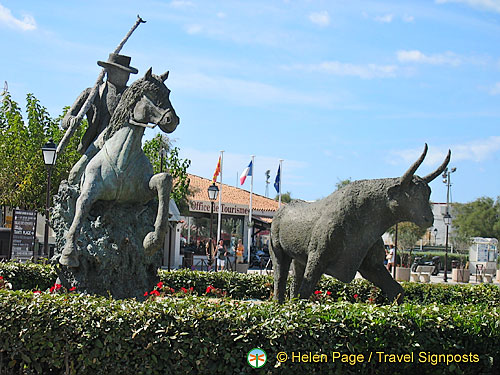
The Cowboys of the Camargue
The Camargue is an interesting region in the South of France, very much like its own separate little country. As you cross into the region, the scenery takes on a huge change. Instead of elegant French chateaux, medieval villages or Roman ruins, you’ll see vast stretches of marshes and wetlands, pastures, dunes and the salt flats which make up the Camargue.
The Camargue region was designated as a botanical and zoological nature reserve in 1927 and 1970 and this has helped to conserve its natural wild beauty. A unique variety of flora and fauna flourish here, so be on the lookout for flamingos, egrets, ibises and other species.
The Camargue black bulls are very much part of the landscape and bulls have lived here in the swamps since Roman times. Like the bulls, Camargue horses roam freely here. These small, white, sturdy horses are believed to be one of the oldest breeds in France and are ridden by the gardians or cowboys. It’s a bit strange to think of cowboys in France, but you’ll certainly see them in town, decked out in boots, hats and all. The Camargue people live a traditional life and the gardians play a big part in keeping the Camargue tradition alive. The gardians are skilled horsemen and each April they show off their horsemanship in the Arles arena.
If you’re interested in birdlife, Spring and Autumn are the best times for seeing the birds of Camargue.
Salt Production in the Camargue
Heading for the village of Saintes-Maries-de-la-Mer, look out for the long lines of salt mountains along the way, drying in the Provencal sun, and the checkerboard salt-pans. The salt marshes (salins) can be found in the southeast corner of the Camargue, near Salin-de-Giraud and the Grand Rhône. Another salt marsh, the Salins du Midi, is located in the southwest corner, west of the Petit Rhône.
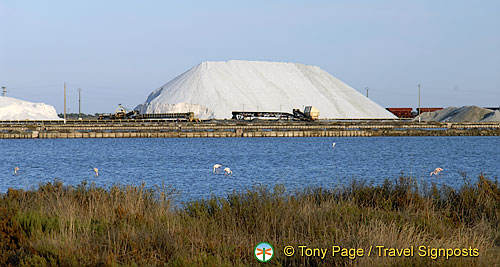
Salt production
Salt production in the Camargue began since ancient times by both the Greeks and the Romans, and continued through the Middle ages. Salt was transported along the Mediterranean coast and then inland on the Routes du Sel (Salt Roads), up into Piedmont.
During the months from March to September, seawater is pumped about 30 km across the salt tables, to form a saturated solution of sodium chloride. The solution is then directed into crystalising pans, about 12 cm deep. The solution evaporates all winter and into the summer. From the end of August until October, the salt crystalizes.
Gypsy Capital of the Camargue
Saintes-Maries-de-la-Mer is the gypsy capital of the Camargue and it is also a compact seaside resort town, filled with shops and activities oriented towards the tourist trade. It was lunchtime when we arrived in town the temperature was scorching. Unfortunately most stalls and shops were closed and so we missed out on checking out the very nice cowboy leather belt in the shop window.
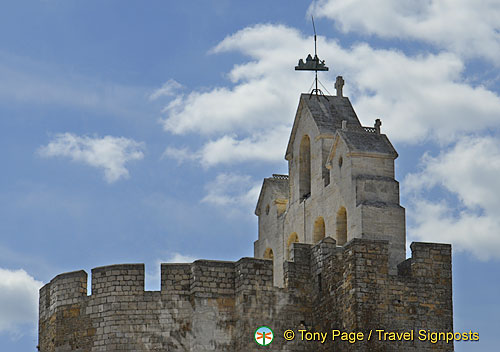
Stes. Maries de la Mer, Camargue
Although the town was very quiet during our visit, Saintes-Maries-de-la-Mer does get busy during their festive seasons.The annual pilgrimage and gathering of the gypsies or gitans takes place here on 24-25 May. The gypsies start arriving in Ste-Maries-de-la-Mer during the preceding week and during this time, marriage requests and baptisms take place. The saint’s day for Mary Jacobe is 25 May. This is also a time to venerate their patron saint, Sarah.
The parish Church of Saintes-Maries-de-la-Mer is the central attraction of this village. Viewed from the outside, the church resembles a fortress due to the height and bulk of the building. Above the entrance door to the church is an original cross. This is the Cross of the Camargue, made up of three symbols:
- At the top is a cross, which is a sign of lived FAITH. This is decorated in cowhands’ forks, which represent daily work.
- The cross is rooted in the sailor’s anchor, representing a sign of HOPE amid the storms of life and the history of humanity.
- The cross is surrounded by a heart, being an invitation to LOVE and to share with those who are near and those who are far away.
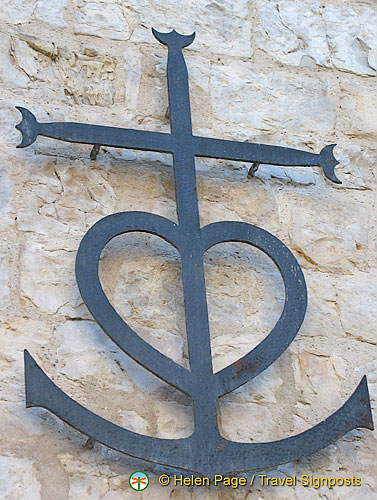
Cross of the Camargue
Who are these Gypsies?
So who are these gypsies and where do they come from? There appears to be no written record of when gypsies arrived at Saintes-Maries-de-la-Mer, but they are believed to have been here since time immemorial. It is reckoned that they migrated from the north-west of India around the year 900. Having got as far as Persia, they broke up into different branches, then spread out throughout Europe and beyond. In nearby Arles, they are recorded as having been there in 1438.


 Take Better Digital Photos eBook
 Guerrilla Travel Photography eBook
Leave a Reply