Casa di Giulietta – Romeo and Juliet – An Immortal Love Story:
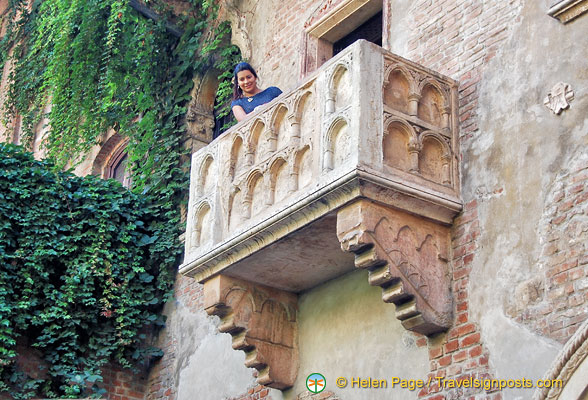
Juliet’s Balcony, Verona
Centuries after Shakespeare wrote his famous tragic romance Romeo and Juliet, more than half a million people still pack into the courtyard of Casa di Giulietta each year to see the famous Juliet balcony. It was from this balcony that Juliet was supposed to have spoken her famous lines in Shakespeare’s play and Juliet’s balcony is easily the most popular tourist attraction in Verona.
Casa di Giulietta
A short passageway, covered with graffiti, leads to the small courtyard of Casa di Giulietta. Juliet’s House, at No. 23 Via Cappello, is a residence of medieval origin. This house, together with a cluster of surrounding buildings, had been the official property of the wealthy Dal Cappello family since the 1200s. From this derives the name Capuleti, the noble house to which Juliet belongs. Even today, a coat of arms depicting a hat (cappello), carved in stone, adorns the house.
Casa di Giulietta has been a place of pilgrimage for Shakespeare fans, travellers and young lovers. The young in particular come to Verona to pledge their love to each other. On the covered passageway to Juliet’s house are thousands of scrawled love messages and in an act of sealing their love, young lovers also place colourful padlocks on an iron gate next to the giftshop.
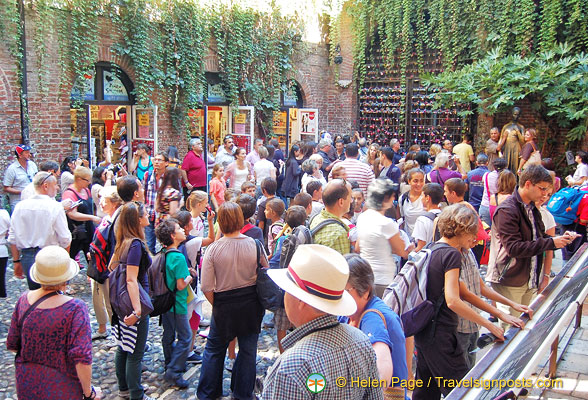
Juliet’s Courtyard
From the courtyard, you can see the famous balcony where the young star-crossed lovers were supposed to have met secretly. During the summer season, the courtyard is packed with visitors, all wanting to take a look at the Juliet balcony and pose for photos. If you don’t like crowds, plan on a winter visit when it is much quieter and more serene.
Although this stone balcony was not a feature of the original Capuleti residence and is believed to been a part of an antique sarcophagus, nothing gets in the way of a good romance story. Young couples are happy to pay the entrance fee to The House of Juliet Museum so that they can pose on the balcony and have their Romeo and Juliet moment.
But it is not just the young who are drawn here by this love story, luminaries such as Charles Dickens have also visited. In his travelogue, Pictures from Italy, Dickens describes in detail his visit to the House of the Capulets, which by that time had been turned into a “miserable little inn”. Even though it is fiction, those who have read and love Shakespeare’s play will find it quite moving standing in the courtyard and sharing the view of this famous balcony with Shakespeare lovers from the world over.
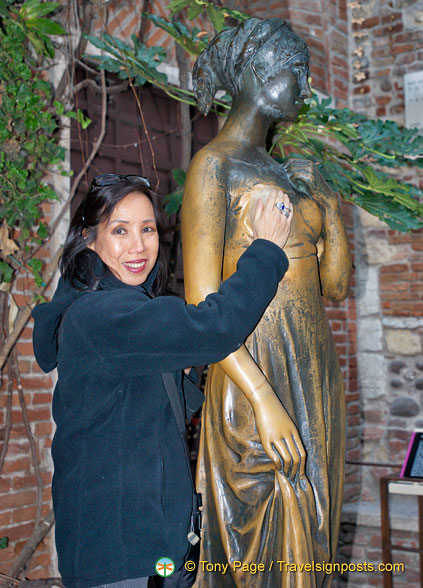
Touching Juliet for Good Fortune
Bestowing Good Fortune
A beautiful bronze statue of Juliet, created by the Veronese sculptor Nereo Constantini in 1972, stands elegantly in the courtyard. Her right breast is worn bare by the number of visitors cupping their hands over it. It is believed that by touching the right breast of Juliet’s statue, good fortune will be bestowed upon you. Never one to fore-go the opportunity for some extra good luck, I too had a go. A group of giggly schoolboys no doubt had other naughty thoughts on their minds when they touched Juliet’s breast.
Through the immortal love story of Romeo and Juliet, still the staple of high school English classes today and translated into music, the visual arts, dance, cinema and opera, Shakespeare has given Verona perennial fame.
See Travel Signposts Casa di Giulietta Photos Here
Map of Verona
23, 37121 Verona VR, Italy


 Take Better Digital Photos eBook
 Guerrilla Travel Photography eBook
Leave a Reply