The Colosseum or Coliseum Was A Roman Amphitheatre Where Gladiators Dared Tread:
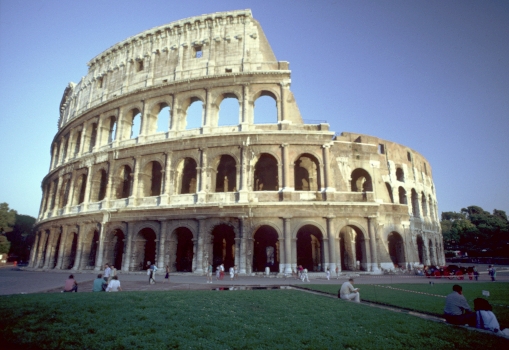
Colosseum or Coliseum © Travel Signposts
The Colosseum or Coliseum or Il Colosseo as the Romans refer to it, began life as the Flavian Amphitheatre, an enormous elliptical stadium capable of seating 50,000 spectators within its six acre domain. Millions of people come to visit the world’s most famous amphitheatre each year, made more famous by Ridley Scott’s Gladiator movie.
Opened in 80 AD after eight years of labour by 15,000 slaves and engineers, the Colosseum gained its now-common name from the Colossus, a 40m (130ft) nearby statue. Thought to have once had Nero’s likeness, the statue’s head was replaced several times to display the face of a succession of Roman emperors down the years. Evidence of the base of the bronze giant can still be seen between the Colosseum and the Temple of Roma and Venus not far away.
Colosseum Seating
The seats in the Colosseum are arranged in layers, almost all of which look out over the many levels of arch upon arch surrounding this vast expanse. Sitting in one, a visitor can almost hear the roar of the crowd as the Emperor’s retinue enters through one of the four entrances used solely by them. The other 76 were for the average Roman citizen.
Seating was arranged by rank – the Emperor had a box near the base, the most prestigious section, while the women who were not part of the Royal party were relegated to the upper levels. But even from there it would not have been too difficult to see the results of the combat. Even from that height it would not have been to hard to see rhinos, hippos and elephants who were used in the ‘shows’ along with the more well-known lions and tigers.
Gladiators and Blood Sport
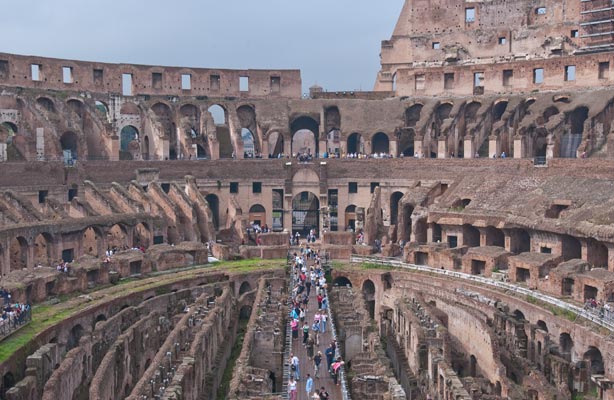
Rome Colosseum © Travel Signposts
During the 1st century AD, and for hundreds of years thereafter, the Colosseum was host to grisly spectacles of human-to-human and human-to-animal combats. Slight evidence of those activities remains among the ruins, chiefly the underground vaults and tunnels that served as storage and entrances for the combatants.
For 100 days after its debut, the arena was host to celebrations both noble and barbarian (to modern eyes). Fights to the death among enslaved gladiators, Roman versions of lion taming, considerably harsher than modern circus acts and many other displays of violence were common fare.
Fire and earthquakes, but still standing…
Though the building has suffered repeated fire and earthquake damage over the centuries, remnants of its ancient glory can be seen in numerous places.
The masts and velarium – a canopy covering part the large area to provide shade – have disappeared, long ago succumbing to the changes of the ages. But the immense columns and walls remain, ranging from Doric on the first story, to Ionic on the second, finishing with Corinthian on the third.
Looking over the huge arena from atop its 48m (157ft) height, it isn’t difficult to imagine the show below as if it had happened only yesterday. True, the red brick arches are crumbling and the slaves and lions are long gone. But this popular Roman site remains alive with the ghosts of battles past and the many tourists in its present.
The Colosseum restoration project included a wooden path that crosses the arena, allowing visitors a better view of the chambers and dungeons where exotic animals and slaves were once kept before fighting.
Subterranean passageways, now open to the public
Beneath the Colosseum, archaeologists have dug up a network of subterranean passageways, such as a private passage built by Emperor Comodus, the villain of the Gladiator movie. The passage, which is six meters underground, connected the imperial box inside the Colosseum with an unknown point outside. Experts believe it was probably used as an Imperial emergency exit. Other passageways were once used to transport wild animals and gladiators to the arena. The passageways were opened to the public in summer 2010.
The Colosseum, even today, forms the basis of arenas around the world. It was one of the first, and certainly the largest and most well-known, to be free-standing. Most prior examples had been dug out of a hillside, of which many exist in and near Rome.
No visit to Rome is complete without a tour of the Colosseum. For first time visitors, a guided Ancient Rome and Colosseum tour provides the ideal introduction.
The easiest way to get there is on the metro – “B” line Metro station Colosseo. The Colosseum is just across the road from the metro exit.
Address:
Piazza del Colosseo – 00184 Roma
Map of Rome:
1, 00184 Roma RM, Italy


 Take Better Digital Photos eBook
 Guerrilla Travel Photography eBook
Leave a Reply