The Pantheon Still Has The World’s Largest Non-reinforced Concrete Dome:
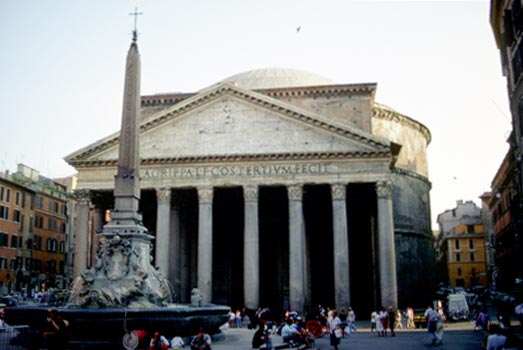
The Pantheon, Rome © Travel Signposts
Few ancient buildings have survived the ravages of time so well as the Pantheon in Rome. Up to this day, the Pantheon’s dome is still the world’s largest non-reinforced concrete dome. And nearly two thousand years after its birth the Pantheon is as stable today as when it was first built. The fact is no accident – it’s largely the result of superior Roman engineering.
The Pantheon was originally commissioned by Marcus Agrippa as a Temple to All the Gods of Ancient Rome and rebuilt by Emperor Hadrian around 125 AD. Often copied, sometimes equaled but never surpassed, the Pantheon had more architectural innovations than most modern buildings. All the more remarkable, given the period that it was built.
The plan is simple enough: a circular enclosure aside a rectangular entrance. The entrance sports a classic Greek portico of granite columns topped by a triangular pediment. There are three ranks of Corinthian supports, eight in front and two sets of four further in leading to the main rotunda. A rectangular section joins the portico to the rotunda.
But within that simple design are a dozen signs of genius.
The Pantheon’s Dome
The giant concrete dome topping the cylinder forming the major component was so well designed and built that no similar type would stand up under its own weight.
The dome is 142 feet in diameter, while the oculus at the peak is over 25 feet of that total. It stands as a result of its unusual composition, outstanding engineering and brilliant construction.

Pantheon’s Dome © Travel Signposts
Just one example is the oculus in the centre – the opening through the top. It decreases the overall weight and serves as a ring that distributes stress around its circumference.
It also serves to admit light to the interior. And rain, too it must be said, though the floor is an early example of slanting the floor toward drains.
The dome’s tapering steps provide yet more evidence of the mastery of craft displayed by the dome’s designer. It’s 20 feet thick at the base, 7.5 at the oculus and composed of heavier material at the bottom, lighter as it rises. That doesn’t seem so remarkable until one considers that many architects a thousand years later ignored this simple idea.
That the Pantheon is as stable today as when it was first built is remarkable considering it was constructed without the benefit of machines or modern tools. Nor did the Pantheon engineers have the advantage of modern transportation methods. All the materials were floated down the Tiber and moved to the site by man and animal on carts of the period.
Though its enormous bronze doors have been restored many times, no major structural work has ever had to be undertaken. This is all the more remarkable given the marshy land on which the structure is built.
By comparison, observe there have been several decades-long projects to preserve the Leaning Tower of Pisa, owing in part to the soft ground in parts of the site. The Parthenon in Greece, though a great building, was a virtual ruin 2,000 years after its birth.
The Pantheon in Rome was first converted to a church during the 8th century and continues to serve that purpose today. In fact, the building has been in continuous use since first being built.
This amazing building has often been copied, two notable examples being the British Museum Reading Room and the Thomas Jefferson Rotunda at the University of Virginia.
Today, the interior of the Pantheon is lined with tombs of Italian monarchs. In the third niche is the sarcophagus of Raphael. His fiancée, Maria Bibbiena is buried to the right of his sarcophagus – she died before they could marry.
Map of Rome: Pantheon
00186 Roma RM, Italy


 Take Better Digital Photos eBook
 Guerrilla Travel Photography eBook
Leave a Reply